
Lessons from a $250MM precision operation...

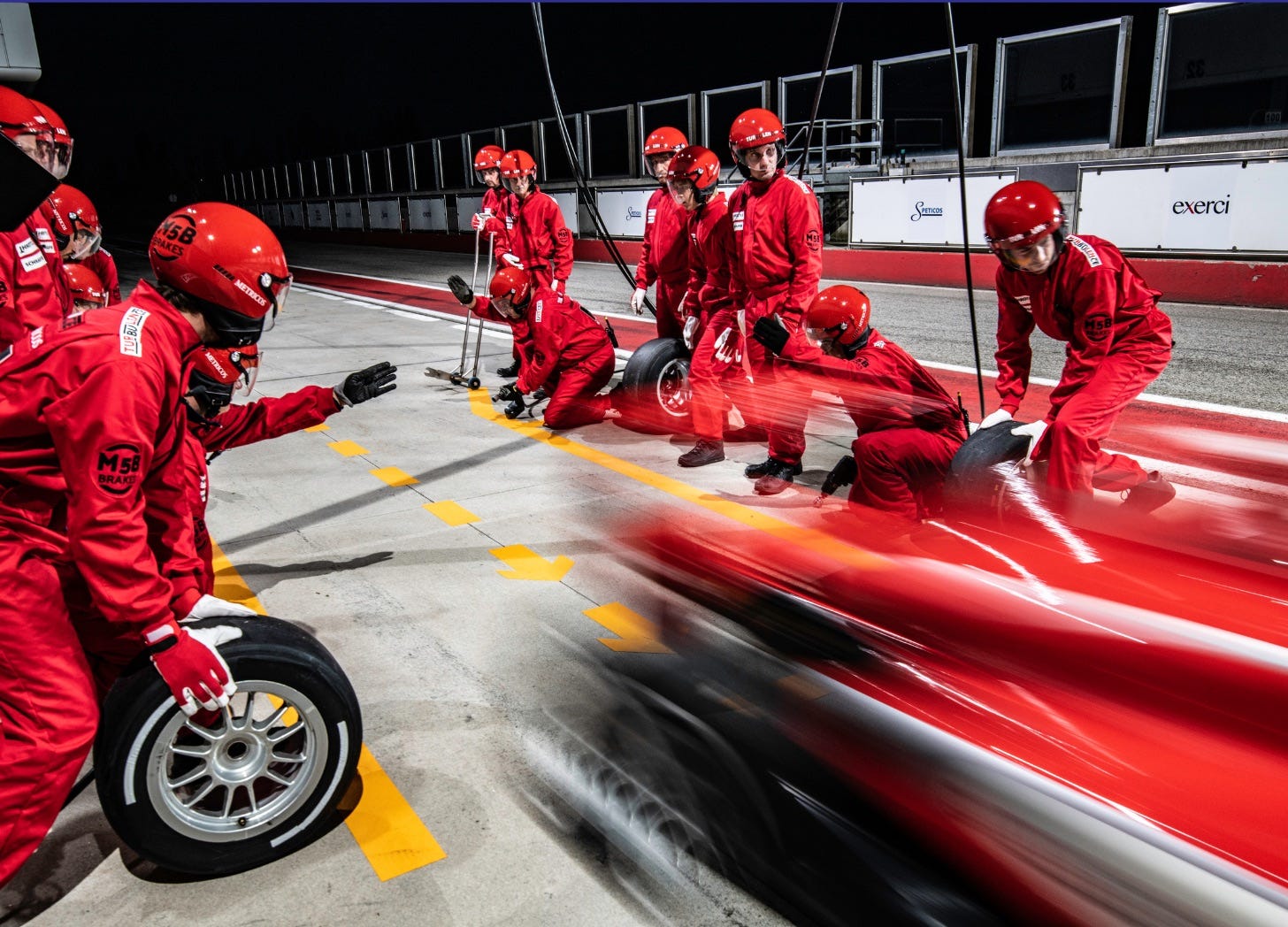
I've become a huge fan of Formula 1 over the last few years.
I'm endlessly fascinated by everything from the extreme forces, to the precision of the drivers (while under extreme forces)...
Thanks for reading Deacon’s Notes on Ops! Subscribe for free to receive new posts and support my work.
And as an Operator myself, I'm even more impressed with the orchestration behind the scenes to pull it all off.
Imagine this...
To build a modern Formula 1 car takes a team of hundreds of engineers working constantly. These engineers have to decipher volumes of technical requirements to design a 'legal' car, and in the end it comes down to millimeter precision.
These cars have to be designed to withstand the extreme forces of a crash at over 200mph as well as the impeccable scrutiny of the race officials (yes, they laser scan every inch to ensure it's legal).
At each race the teams will generate 1 Terabyte of telemetry data on everything from the temperature of tires to the battery discharge rates.
Hundreds more engineers will sift through the data and make millimeter adjustment recommendations to the team ahead of the next session in hopes to gain thousandths of a second.
All while remaining under a strict budget cap of $250 Million in annual spend.
The person in charge of pulling all of this together - the Team Principal, has the enormous job of orchestrating and managing the available resources to ultimately win.
By the time you get to the actual race day it's largely already been won or lost - and that's what I find fascinating.
Now here's the part that applies to you and me...
I've been studying what it takes to run an organization of this complexity, speed, and precision. I was expecting to find a set of incredibly detailed processes lifted out of NASA or something.
But instead, I found something familiar and comforting.
The best organizations are built on communication and leadership. That's it.
Ross Braun, one of the most successful leaders at this level, recounts how he led Ferrari to unprecedented success through a series of small, conscious, consistent actions.
For example...
He believed in groups working closely together. He literally rearranged the campus of Ferrari to ensure the engine teams and the chassis teams were next to each other. He'd send his own team members off to work at the tire manufacturer and pay to bring their team members into the Ferrari factory.
It was about sharing knowledge and breaking down silos. Braun knew that the only way to create one high performance machine was to treat the teams like one cohesive unit.
And on his way to the office every day in his executive suite, he carved out an extra 45 minutes to walk through the factory and chat with the team on the floor. He knew he needed to see and be seen to both win the respect and keep his finger on the pulse of the organization.
If you were to look back at Ferrari's dominance and put your finger on the reason for their success you'd probably talk a lot about their car - how the engine was superior, or how the chassis was top notch, or even how they worked so well together.
What Braun is demonstrating here is this...
Those high performance car parts are the result. But as a leader, he was focused on creating an environment that created the car parts.
That's what leading is all about.
It's not about doing the thing. Or driving the thing. Or being the one who creates the result.
It's about creating the environment where results are inevitable.
What would your organization look like if it were designed to create high performance results?
To your growth,
Deacon
PS: I work with small business leaders to help them design high performance teams. If that’s something you might need, shoot me a message.
Thanks for reading Deacon’s Notes on Ops! Subscribe for free to receive new posts and support my work.